
AI and intelligent automation
Practical AI, built on the technology you already own
We help organisations move from ad hoc AI use to structured, secure solutions that work with their existing Microsoft technology, people and processes. We understand the business challenge first, choose the technology second, and demonstrate the value before anyone commits to wider implementation.
Three strands of AI work
Each one draws on the same Microsoft architecture, infrastructure and security experience we bring to every engagement.
AI strategy, readiness and governance
Available now
Where AI can genuinely improve productivity and decision-making, and what has to be in place first. We assess technology, data access, workflows, security requirements and automation opportunities, and help establish AI usage policies and governance that allow innovation without exposing sensitive information.
Typical technologyMicrosoft 365 Copilot, Purview, Entra ID, SharePoint
Microsoft 365, Copilot and intelligent automation
Working demonstration
Making better use of the Microsoft technology organisations already own. We combine SharePoint, Teams, Copilot Studio, Power Platform and Power BI into connected solutions: document retrieval, project reporting, automated processes, AI-assisted analysis and conversational access to organisational information, in one environment rather than another disconnected tool.
Typical technologySharePoint, Teams, Copilot Studio, Power Platform, Power BI
Private and locally hosted AI
In development and testing
Not every organisation wants its AI to depend entirely on external cloud services. We are developing and testing locally hosted platforms that use open-source language models and private knowledge bases, with answers drawn from the organisation's own documents (retrieval-augmented generation). Potential uses include private knowledge assistants, internal technical support and document analysis, subject to appropriate security and governance controls.
Typical technologyOpen-source language models, private knowledge bases, retrieval-augmented generation
AI in practice: a construction and logistics demonstration
A working Microsoft 365 environment, built by Trustpoint, that brings together project information usually scattered across spreadsheets, shared folders, email and disconnected systems.
Business data in SharePoint
- Projects and milestones
- Deliveries and fleet assets
- Commercial information
- Risk management
- Health and safety records
- Supporting documentation
Copilot Studio agent
Answers natural-language questions, retrieves the relevant records and grounds its responses in the business data each user is permitted to see.
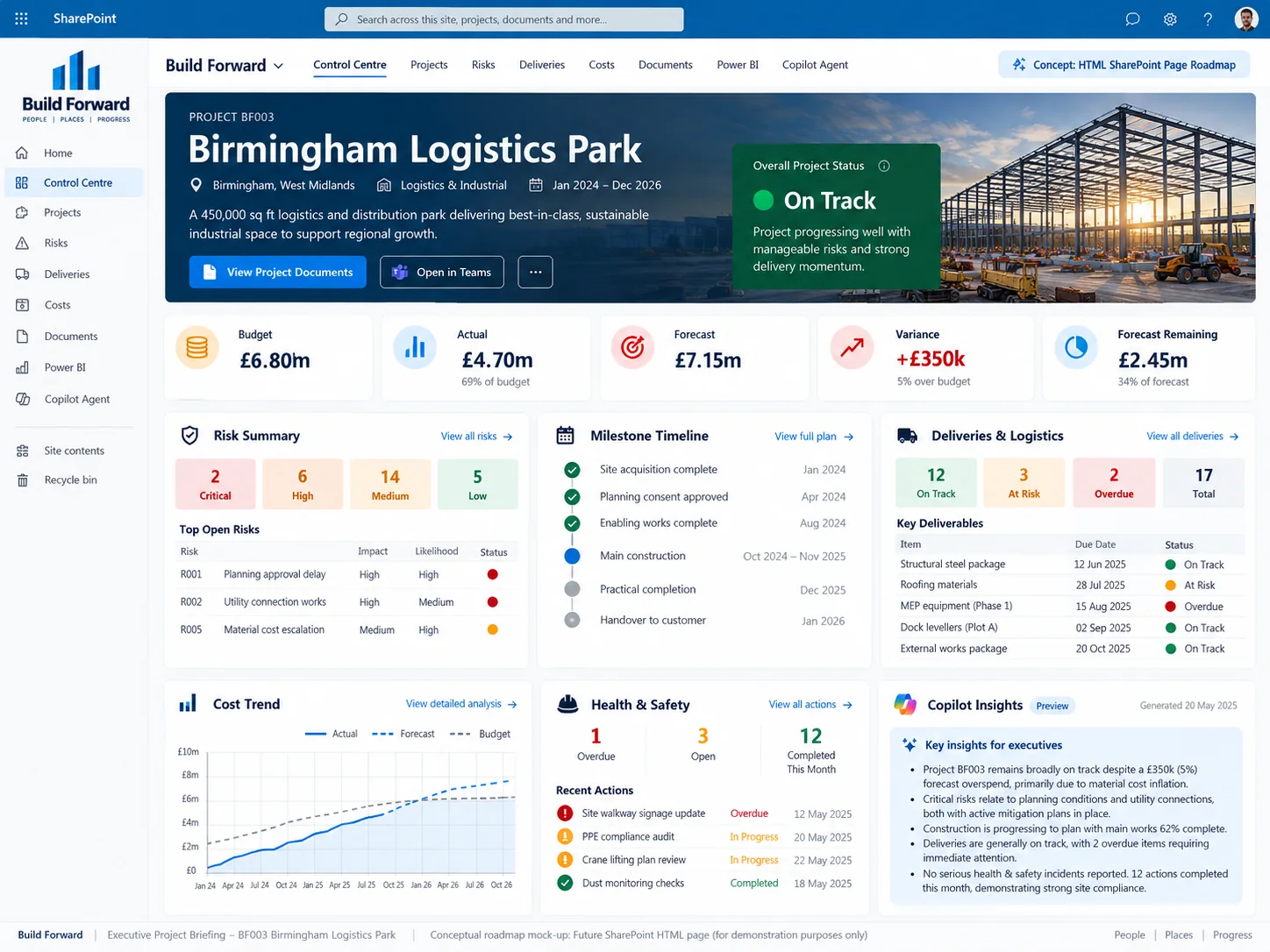
Power BI reporting
Visual insight into project performance, financial commitments, operational activity and areas needing management attention.
In development
Permissions, traceability and human oversight apply across every layer.
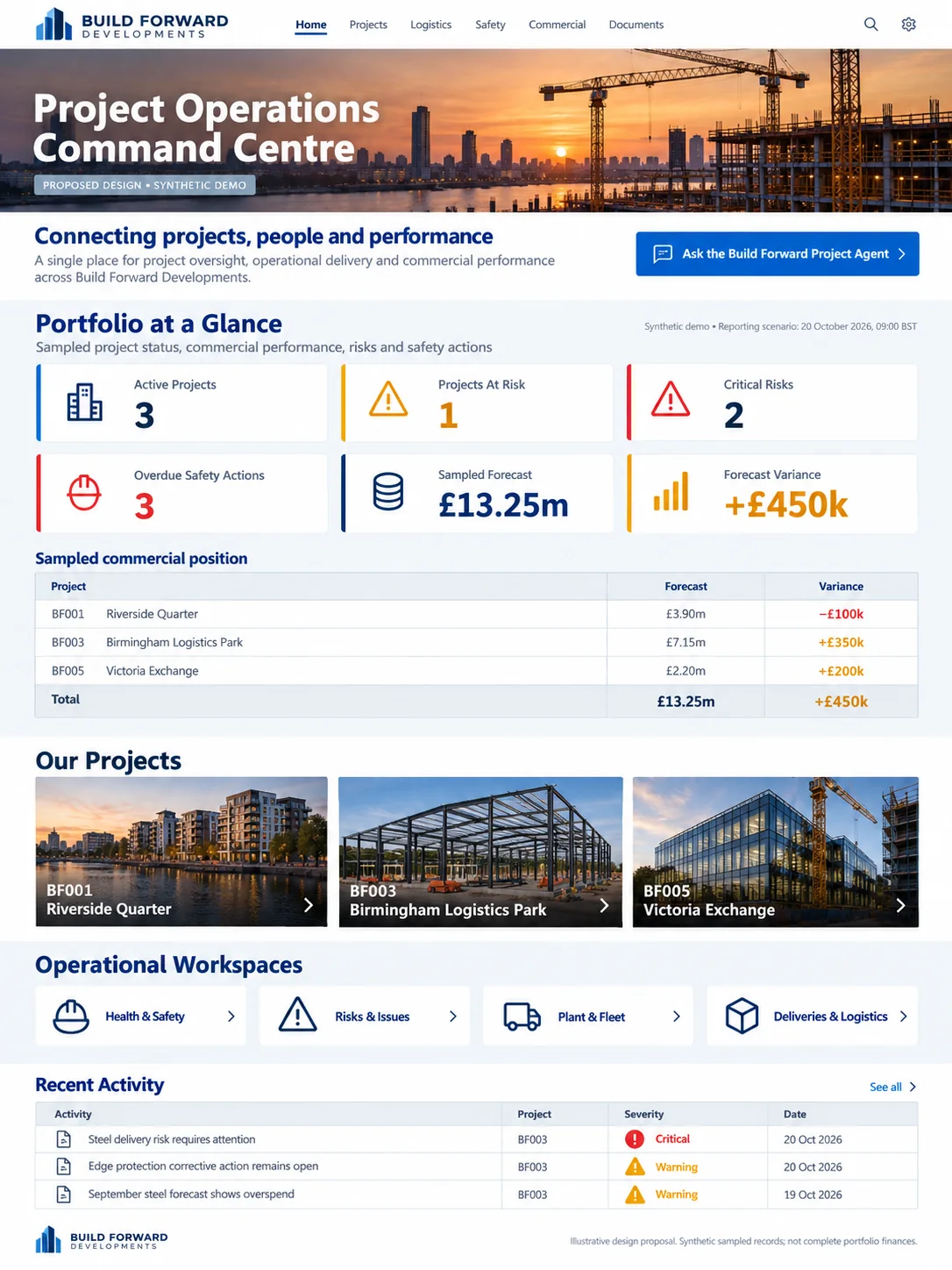
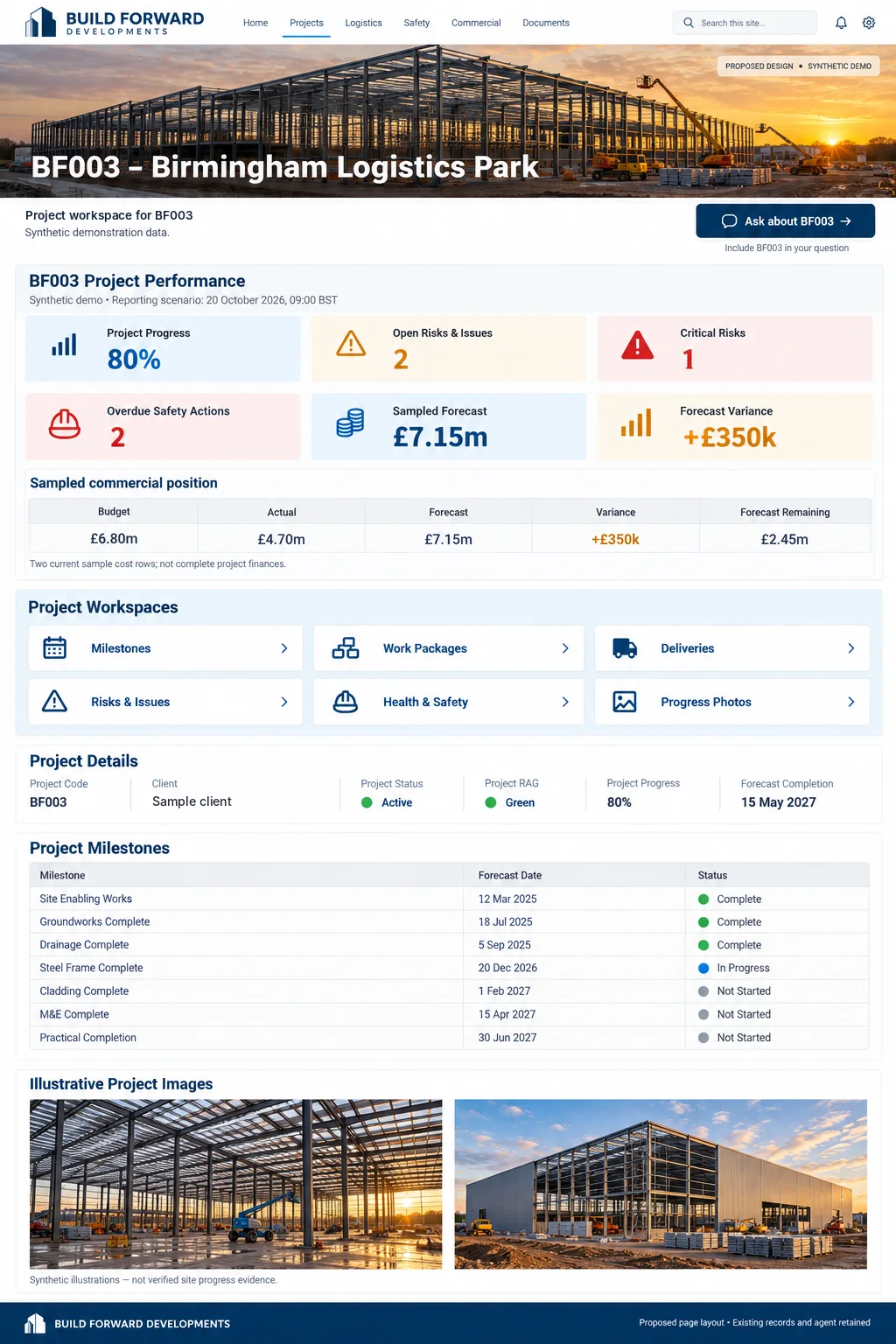
Build Forward Developments is a fictional company created for this demonstration. All projects, figures and images are synthetic. Select an image to view it at full size.
What people can ask
- How is this project tracking against its commercial budget?
- Which risks are still open, and who owns them?
- What deliveries are due on site this week?
- Find the latest health and safety documentation for this site.
What it shows
Its strength is not any single AI feature but the way structured data, document management, reporting, AI and security combine into one coherent business solution. The same architecture applies to any organisation whose information sits across several systems.
A working proof of concept using illustrative data. It reflects the architecture and integration considerations of a real deployment, and is not a client project.
Before AI is switched on
Copilot and AI agents work within the permissions and data an organisation already has. Four questions need clear answers first.
What can people already see?
AI surfaces whatever users have access to. We review SharePoint, Teams and OneDrive permissions for oversharing before it becomes an AI problem.
Is the data classified?
Sensitivity labels and data loss prevention in Purview decide what AI may use and where its outputs can go.
Is identity in order?
Stale accounts, broad groups and unmanaged guests carry straight into AI. Identity hygiene comes first.
Who owns the outputs?
Clear ownership, acceptable use and a view of where human judgement stays primary, agreed before adoption rather than after.
How we approach AI
Successful adoption is not about replacing people or adopting technology for its own sake. It is about less repetitive administration, more useful information, better visibility and more time for valuable work.
The business challenge first
We start with the process and the people, and choose the technology second.
Demonstrate before scaling
Value is shown in a bounded proof of concept before wider implementation is committed.
Bounded experimentation
Pilots have a defined scope, defined data and a defined owner, so learning scales without divergence.
Human judgement stays visible
It is always clear where AI is influencing an outcome and where a person remains accountable for it.
Talk to us about AI
You don't need a fully developed AI strategy to start a conversation. If information sits across disconnected systems, reports take too long to produce, or you are wondering where AI could help, tell us.